

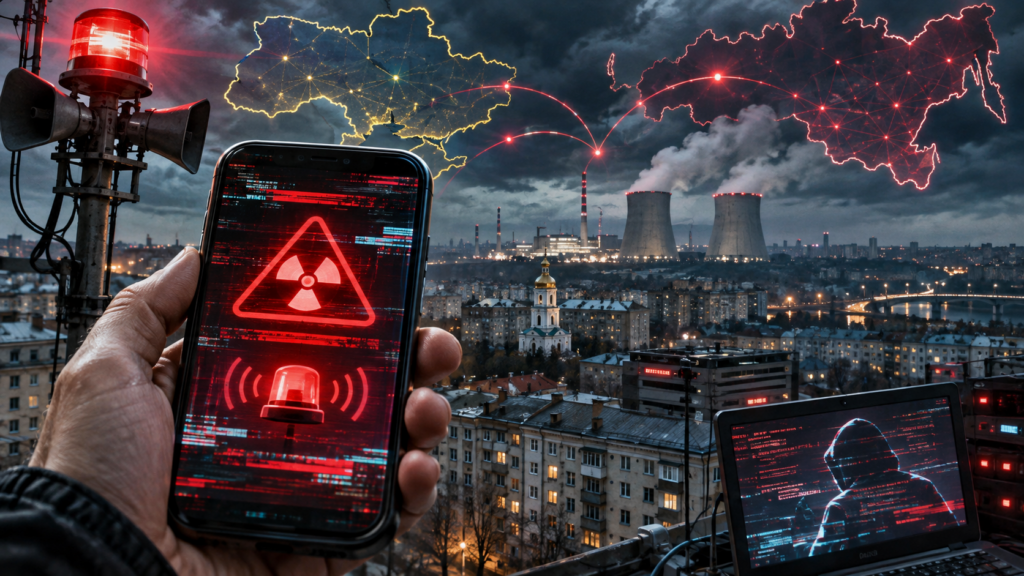
KYIV/MOSCOW – On the night of Sunday, November 1 to Monday, November 2, 2026, residents in both Ukraine and Russia received fake nuclear and chemical threat alerts on their mobile warning applications. These cyber attacks targeted digital platforms crucial for alerting the public to air raids, missile launches and other emergencies. The Ukrainian Air Force was quick to calm fears, confirming there was no radiation danger. Soon after, Russia’s Ministry of Emergency Situations reported a comparable attack on its own civilian warning app. The parties responsible for either incident have not yet been independently identified.
The incidents affected a highly sensitive sphere of civilian protection. Amid ongoing war, reliable mobile alerts are a vital resource for civilians seeking timely shelter.
According to available information, the attacks did not disable entire state warning systems, but exposed how digital components can be used to spread panic.
Ukrainians received radiation and chemical attack warnings
Ukrainian users of the Air Alert app, which notifies of air and missile strikes, were the first to report the issue.
Late Sunday evening, false messages began to appear in the app.
Some alerts claimed there was dangerous radiation in Kyiv, others warned of a chemical attack or even street fighting.
One notification even suggested an imminent strike with a Russian Oreshnik missile.
Alarming references to nuclear and chemical threats understandably stoked severe public anxiety.
The Ukrainian Air Force publicly stated there was no actual radiation threat.
Officials suggested the app had likely been subject to unauthorized interference.
Oreshnik missile name used in fake messages
One of the fake notifications was written in Russian and mentioned the Oreshnik missile.
This refers to a Russian ballistic missile system presented by Moscow as having high speed and destructive power.
Using its name in a fake warning could amplify the psychological impact of the attack.
For Ukrainians who live with daily missile alerts, a fabricated warning about an especially dangerous weapon could spark an immediate reaction.
However, simply displaying the missile’s name does not mean it was actually launched.
Ukrainian authorities confirmed there was no nuclear or chemical attack related to the incident.
Ukraine temporarily disables warning app
Once the suspicious activity was detected, the app’s operators publicly confirmed unauthorized interference with the service.
They temporarily limited the app’s functions to prevent further spread of fraudulent notifications.
Users were advised not to click on any links included in suspicious messages.
The Ukrainian Air Force recommended that the public rely on its official information channels.
Later updates indicated the app’s service was restored during the night.
It is important to note that disruption of a single mobile app does not equate to disabling Ukraine’s overall air defense or all civilian warning systems.
According to local officials, Kyiv’s separate municipal alert system remained operational during the attack.
Similar attack reported in Russia
Several hours later, Russian authorities reported a comparable cyber incident.
The Russian Ministry of Emergency Situations announced a large-scale attack on its warning application.
According to the ministry, attackers were able to deliver false notifications to users.
Some messages made reference to the use of nuclear warheads.
Russian officials reported false alerts had been distributed in 33 regions.
The ministry responded with technical measures to repair the service.
Russian authorities also stated that the main civilian warning system continued to operate normally.
Therefore, this incident cannot be classified as a full-scale paralysis of Russia’s civil defense systems.
Who is behind the attacks? Both sides point to adversaries
The question of responsibility remains unresolved.
Ukraine’s Centre for Strategic Communication, SPRAVDI, blamed Russia for the attack.
Russia’s Ministry of Emergency Situations confirmed its app had been hacked but did not officially name a perpetrator.
Some hacker groups claimed responsibility for the incidents online.
However, these statements have not been verified as independent technical evidence.
There is also no confirmation that the same group conducted both attacks or that they were a coordinated operation.
Attribution is particularly complex in cyber incidents as attackers can use foreign infrastructure, conceal their identity, or plant deliberate false leads.
Why are attacks on civilian warning systems so dangerous?
Warning applications have a single crucial task: delivering reliable information to the public before danger strikes.
If an attacker manages to send fake messages through such an app, several risks emerge:
- Panic: People may react to non-existent nuclear or chemical threats.
- Loss of trust: Repeated false alarms might cause residents to ignore real warnings.
- Disinformation: False alerts can spread rapidly via social media.
- Security threat: Users might click malicious links included in fake notifications.
- Communication breakdown: Temporarily disabling the app removes a key channel for civilian safety.
The most serious long-term consequence could be the erosion of public trust.
If people lose confidence in alerts, they may underestimate a genuine missile or drone strike in the future.
Cyberattacks occur amid ongoing air raids
These digital incidents happened as Russia and Ukraine continue active military operations.
Russian forces are conducting missile and drone strikes against Ukrainian cities and infrastructure.
Ukraine is targeting specific sites within Russian territory, including energy and logistics facilities.
Ukrainian President Volodymyr Zelenskyy recently warned, at the end of October, that Russia was preparing more ballistic strikes.
Further details were reported by Aktualizovane.sk (in Slovak): Russia planning new ballistic attacks, Zelenskyy demands more Patriot missiles.
In these circumstances, reliable civilian warning systems are of vital importance.
Attacks restarted after local truce ended
The cyber incidents also occurred shortly after the end of a temporary local truce in the Kherson region.
The agreement had allowed for the evacuation of civilians and humanitarian aid in the occupied area near the town of Olešky.
After the truce ended, Ukrainian authorities reported new Russian attacks.
The situation remains especially sensitive in places where civilians are within range of artillery, missiles, and drones.
In such attacks, civilian safety often depends on how quickly accurate warnings are delivered.
This underlines why breaches of warning apps carry consequences far beyond a simple technical glitch.
Cyber warfare knows no borders
The Ukraine-Russia conflict has long spilled beyond traditional battlefields.
Cyber operations can target information systems, government services, energy infrastructure, and digital communication.
The goal is not always data theft or direct technical damage.
Sometimes, the main objective is psychological — to erode public trust.
Such attacks are also reported outside war zones.
Aktualizovane.sk previously reported that Norway faced a major cyberattack targeting state digital services.
In that case, a pro-Russian hacker group claimed responsibility, though its statement was not definitive proof of its involvement.
How to respond to suspicious warnings
If users receive very serious alerts that seem unusual or contain suspicious links, they should double-check the information.
Key advice includes:
- Verify information via official government channels.
- Do not click on suspicious links in irregular notifications.
- Monitor other warning channels, especially if app operators report technical problems.
- Avoid spreading unverified messages as confirmed facts.
At the same time, during real threats, one should not delay in taking shelter or ignore civil defense instructions while waiting for lengthy verification.
It is essential to use reliable information sources and follow the latest safety instructions.
Attacks expose digital vulnerability
In both countries, attackers spread fake messages through applications that people rely on for trustworthy safety information.
However, there is no confirmation that hackers gained control over entire national civil defense systems.
The Ukrainian app was temporarily restricted and later restored. Russian officials reported fixing their application as well.
The perpetrators have yet to be independently identified.
These cyberattacks thus revealed a new risk for people in both Ukraine and Russia. At a time when real missiles and drones already endanger civilians, even a single false alert can have serious consequences.
Sources: Pravda, TASR, Associated Press, Reuters, AFP, Euronews, Ukrainian Air Force, Russian Ministry of Emergency Situations. Image: AI illustration
This article was translated from the original Slovak version with the assistance of AI.
