
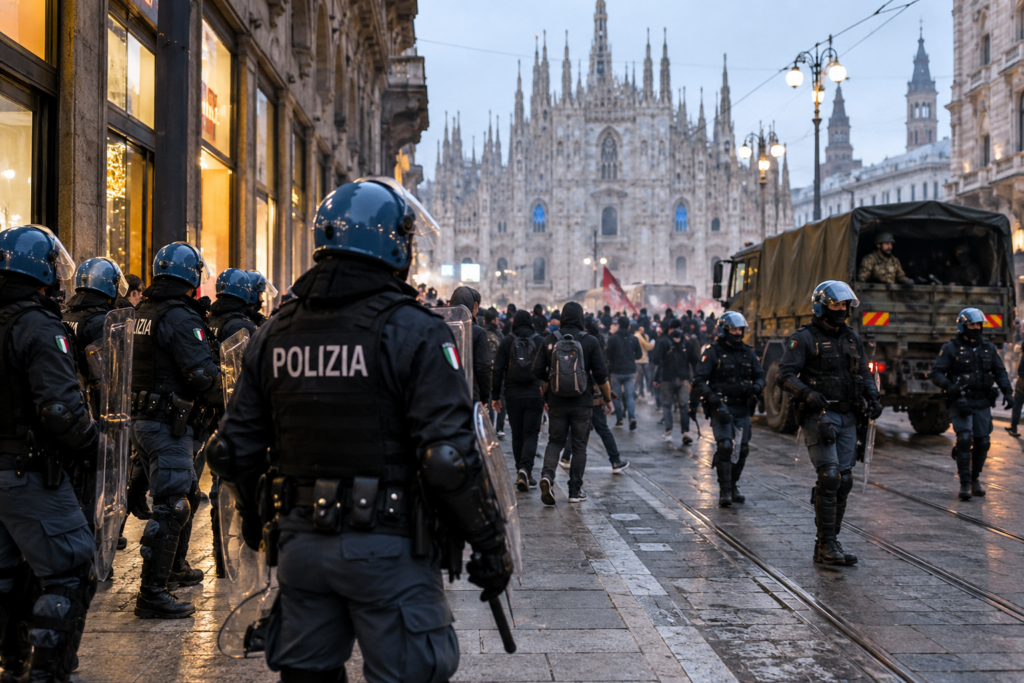
MILAN – The Italian government is responding to widespread street violence with extraordinary security measures. Following a weekend marked by riots, store looting, and clashes with police, authorities have decided to deploy an additional 500 soldiers to Milan. Prime Minister Giorgia Meloni is also moving to tighten security laws, including granting expanded powers to the armed forces and introducing the possibility of preventive detention.
The decision came after a high-level security meeting in Rome on Monday, 19 October 2026, attended by government officials, security forces, and intelligence services.
Italian authorities are concerned about further violence during upcoming demonstrations. The latest measures are meant to shore up safety in the country’s economic center.
Milan rocked by violent protests; Hundreds detained by police
Rioting broke out on the weekend of 17 and 18 October. Demonstrations had originally focused on rising living costs, issues with public services, and dissatisfaction with political developments.
However, part of the protests turned violent.
According to Reuters, masked individuals threw objects at police, destroyed property, and attacked shops. Looting was reported in Milan’s city center.
During Sunday’s unrest, police brought in 271 individuals. Of these, 32 were arrested.
According to data released by authorities, the detainees included 23 minors and 13 foreign nationals. However, these figures alone do not indicate individual responsibility for the violence.
The scenes have sparked particular concern in central Milan, home to many luxury fashion brands.
Some stores acted preventively by removing goods from their displays and securing entrances against possible damage.
Meloni orders 500 more soldiers to Milan
After the security meeting, the government announced an increase in military presence in Milan.
Five hundred additional military personnel will be added to the city to reinforce the existing Strade Sicure security operation.
This is an established program in which the Italian army helps protect key public areas and strategic sites.
The new units will support law enforcement especially in areas threatened by further unrest.
According to Isabella Rauti, State Secretary at the Ministry of Defense, the goal is to increase control over public spaces and prevent a repeat of violent incidents.
The deployment of troops does not mean a state of emergency or a full takeover of police duties by the military.
Soldiers may be granted new police-like powers
The Italian government is also drafting a new security decree.
One change under discussion is to temporarily expand the powers granted to troops serving in the Strade Sicure operation.
Defense Minister Guido Crosetto supports measures that would allow the military to take on some police-like duties for the next three months.
The exact scope of these powers will depend on the final version of the legal reforms.
As of 20 October 2026, several measures were still being debated within the government and had not yet become law.
Tougher rules could also affect minors
Proposals to tighten measures against people suspected of planning or participating in violent unrest have attracted special attention.
According to Italian media, the government is considering extending the possibility of preventive detention to up to 24 hours.
Some of the proposed new rules could also apply to minors.
Authorities are also discussing whether to limit the participation of specific individuals in public gatherings if security agencies identify a legally defined risk of violence.
Another measure under consideration would increase penalties for large-scale property damage during demonstrations.
The government argues these reforms are necessary to prevent more looting and attacks on police officers.
However, such proposals have also raised concerns over their impact on personal freedoms and the right to peaceful assembly.
Violence spreads to other Italian cities
Milan is not the only city where Italian authorities have registered tension.
In recent days, protest gatherings were also held in Bologna, Turin, and other cities in northern Italy.
Not all gatherings followed the same pattern, nor did all of them turn violent.
It remains important to distinguish between peaceful demonstrators and those suspected of criminal activity when assessing police interventions.
The recent unrest in Italy comes amid a broader wave of protests across Europe.
As Aktualizovane.sk previously reported, France has recently seen hundreds of thousands take to the streets in mass protests.
The reasons for each protest differ and not all unrest can be attributed to a single organized group.
Government cites security, critics point to protest causes
Prime Minister Meloni’s cabinet is taking a tougher stance against violence.
According to the government, the state must protect its citizens, public property, and security personnel.
The opposition and critics of the proposed measures say that stepping up repressive tools alone will not address the social root causes of protests.
They argue these causes include rising living costs, lack of access to services, and economic insecurity for young people.
France is facing similar challenges, where protests have become part of a broader political discussion.
Related coverage includes an article on how France is grappling with political pressure regarding the budget, student protests, and upcoming elections.
What’s next for Milan?
Italian security forces are preparing for more protest gatherings in the coming days.
The decision to send additional soldiers aims to stabilize the city after the weekend’s violent events.
The government is also working on legal changes that could alter police and military procedures for handling violent demonstrations.
It remains to be seen how far the new rules will go and how they will work in practice.
Ultimately, the key question is whether authorities can prevent more violence while preserving citizens’ right to peaceful protest.
Source: Bild, Reuters, Euronews, Italian Ministry of Defense. Photo: AI illustration
This article was translated from the original Slovak version with the assistance of AI.
